ROTH2: HYDROGEN UNDER CONTROL
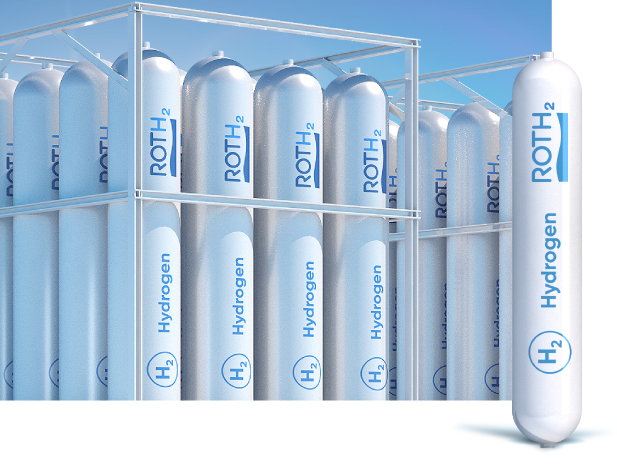
HYDROGEN CYLINDERS UP TO 1000 BARS OF PRESSURE
hydrogen cylinders
ROTH2: HYDROGEN UNDER CONTROL
HYDROGEN CYLINDERS UP TO 1000 BARS OF PRESSURE
HYDROGEN CYLINDERS
ROTH2, FRENCH LEADER
in steel high pressure production
A pressure
up to 1000 bars
The thinness of the hydrogen atom allows it to pass through all packaging materials intended for conventional gases such as propane, oxygen, nitrogen, etc. ROTH2 offers a range of specific tanks up to 1000 bars.
HYDROGEN
A key source
of clean energy.
• its combustion generates a large amount of energy (about 3 times more than petrol at constant weight)
• It is very abundant on Earth in molecular form (water, hydrocarbons, etc.). Hydrogen also exists in its natural state (the first natural sources of hydrogen were discovered at the bottom of the sea in the 1970s and more recently on land, according to IFP Énergies nouvelles;
• its combustion is non-carbon based, with no CO2 emissions…

Tanks dedicated
to your environment.
Stationary applications :
• For mobile machinery
• For industrial process
- applications of hydrogen
- Limits of hydrogen
Hydrogen can be converted into electricity, heat or motive power depending on the end use. It has the advantage of being storable (problematic with electricity) and of being produced without CO2 emissions. Energy storage in buildings by providing electricity and heat through cogeneration, which would enable the development of positive energy buildings. As an energy carrier, it has several applications.
STATIONARY APPLICATIONS FOR MOBILE MACHINERY
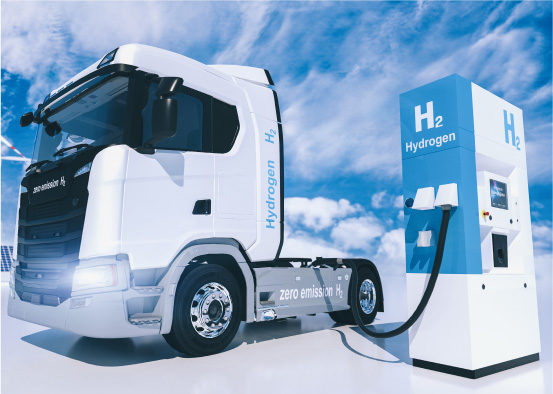
Hydrogen can be used to power vehicles equipped with gas-powered combustion engines. In addition, a hydrogen tank can be combined with a fuel cell to improve the range of electric vehicles (2nd generation electro-mobility, known as 2G, the first corresponding to electric vehicles.
STATIONARY APPLICATIONS FOR INDUSTRIAL PROCESS
Hydrogen is a chemical component widely used in industry.
Hydrogen energy still faces several limitations:
The storage of hydrogen
Storing hydrogen requires large quantities of energy because of its low density (it can be stored in compressed, liquid or metal hydride form). Its transport efficiency (energy transported per unit volume) is much lower than that of oil or gas because of its low density;
there are risks of flammability and detonation with air (although less than for natural gas).
The cost of hydrogen production process
The cost of the most promising hydrogen production process, water electrolysis, remains high;
its use by the general public in transport requires the setting up of a network of hydrogen stations (service stations) which calls for considerable investment.
its use by the general public in transport requires the setting up of a network of hydrogen stations (service stations) which calls for considerable investment.
Hydrogen energy is promising in many ways. Nevertheless, its exploitation on an industrial scale is still in the early stages.
